
How to Search Civil Dockets
For Superior Court, begin at the Georgia Courts E-Access directory, which points users to PeachCourt. Create an account there. Then pick the county and court. An exact case number works best when a notice gives you one. Party-name searches exist too. But spelling errors, the wrong court, the wrong filing year, or a mismatched case-number format can all bury the result. Open the case docket first; check afterward whether a specific pleading or order is viewable.
Magistrate civil records follow a separate path. The county links eFileGeorgia for filing and payment. Its public screen is a login surface, not a free Monroe County civil docket index. When a limited claim fails to appear online, contact the Magistrate clerk. The clerk's office handles copy requests. No universal Monroe court-copy form or same-day email service exists.
- Classify the matter as Superior, Magistrate, Probate, or another court type.
- Use E-Access and PeachCourt for a Monroe Superior civil case.
- Search with the exact case number, or use the full party name and verify the court.
- Read the dated docket entries before opening or buying a document.
- Request the docket sheet, filed order, ordinary copy, or certified copy from the proper clerk.
Choose Monroe Civil Docket Court
Picking the court is the key local step. The Superior Court of the Towaliga Judicial Circuit, Monroe County venue, handles divorce, equity, title-to-land, declaratory, contract, premises-liability, and other broad civil matters within its authority. Monroe Magistrate Court takes money claims under $15,000. It also handles dispossessory, garnishment, foreclosure, and abandoned-vehicle proceedings. Probate Court keeps estate and guardianship matters, which are not interchangeable with either civil docket.
The official Monroe County Magistrate Court page describes small claims as informal. Small claims are decided without a jury and available without an attorney. The county's official pages list no separate current Monroe State Court docket. If a notice names a court, follow that court. Do so even when the parties and courthouse sit in the same county.
| Civil matter | Likely Monroe court | Starting channel |
|---|---|---|
| Divorce, equity, land title, broad civil claim | Superior Court | PeachCourt or Superior Clerk |
| Money claim under $15,000 | Magistrate Court | Magistrate clerk or eFileGeorgia filing route |
| Dispossessory, garnishment, listed limited filing | Magistrate Court | Magistrate clerk |
| Estate or guardianship | Probate Court | Probate clerk |
What a Civil Docket Shows
Uniform Superior Court Rule 39.2 offers the best public field inventory for a Monroe County Superior civil docket. Live case access sits behind a login. The rule describes what the clerk's docket is built to retain. It does not promise that every PeachCourt screen shows every field or document image.
| Action number | The unique civil docket identifier; copy its exact letters, digits, and punctuation. |
|---|---|
| Parties and counsel | Indexed parties and their attorneys, subject to privacy rules and access limits. |
| Filing and service | Filing date, costs, service date and type, and summaries of pleadings and motions. |
| Settings and trial | Trial date, jury or nonjury status, judge, and related docket proceedings. |
| Disposition | Dismissal, settlement, judgment type, final decree, transfer, or other recorded result. |
| Later record | Fi Fa date, transcript, appeal, remittitur, and cross-references to minutes or stored records. |
A docket entry and a filed image are separate things. Read the entry, then ask for the order when its exact terms matter.
Monroe Civil Filing Systems
Monroe County civil filing splits across two named electronic systems. The Georgia provider table makes PeachCourt mandatory for Monroe Superior Court e-filing. For Magistrate civil filing and payment, the county links eFileGeorgia. Treat neither label as one public index for every civil docket.
The eFileGeorgia filing portal is a filing and payment gateway. It opens only past a login. That is the boundary its official page shows.
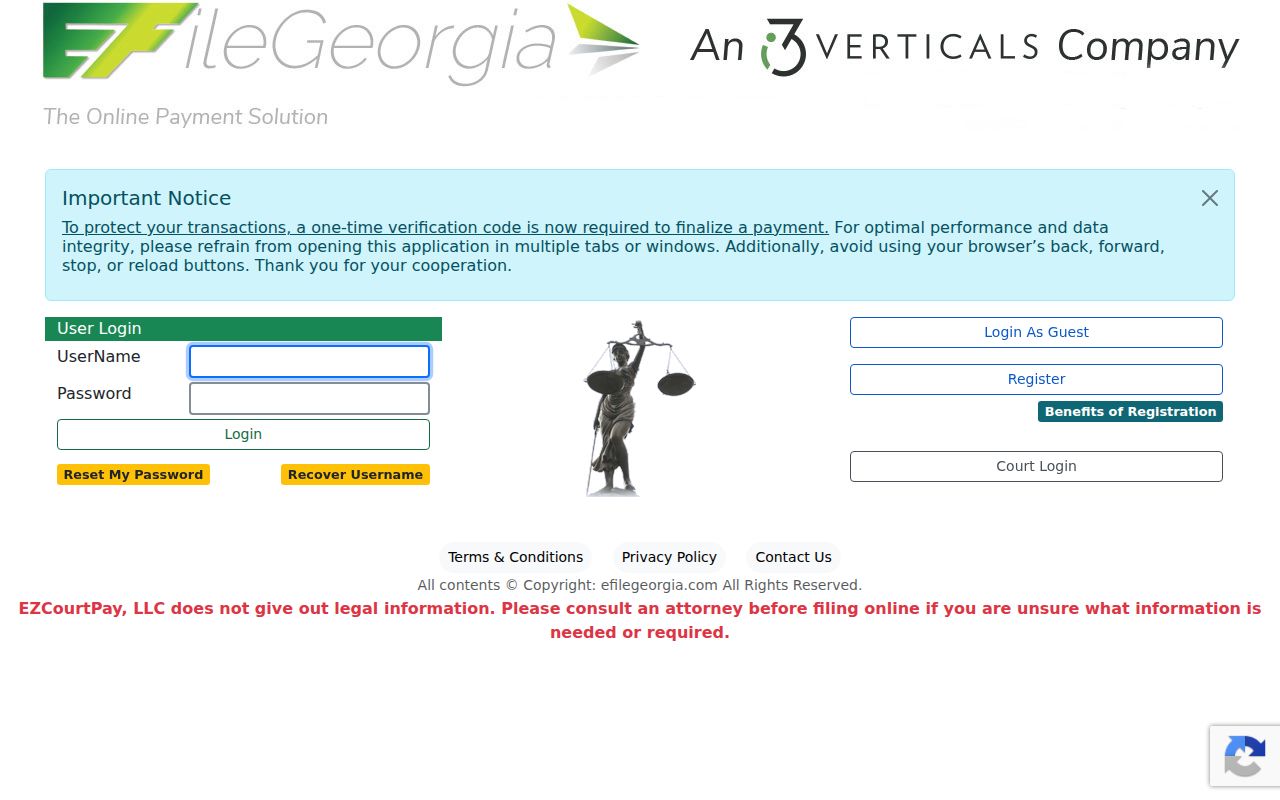
The page shows a filing and payment gateway. An unregistered visitor cannot assume it searches all Monroe County civil case records.
| System | Court use | Public limit |
|---|---|---|
| PeachCourt | Superior filing and case or document access | Account required; documents and coverage vary |
| eFileGeorgia | Magistrate civil filing and payment workflow | Login-oriented, not a verified free case index |
| Clerk counter or phone | Copies, older records, access questions | Confirm method, cost, and record custodian |
Types of Civil Cases on the Docket
Monroe County civil dockets span distinct court roles. Superior civil matters can include divorce, equity, title to land, contract disputes, premises claims, and other cases within that court's broad jurisdiction. Magistrate filings include statements of claim and several limited statutory proceedings. Probate records belong to a separate clerk and are not Superior civil cases.
- Superior complaints, petitions, equity matters, and domestic-relations actions
- Magistrate statements of claim for money within the court's limit
- Dispossessory proceedings and related service entries
- Garnishment, foreclosure, abandoned-vehicle, and Fi Fa filings listed by the local court
- Probate estates and guardianships held through the Probate Court channel
Rule 39.2 also requires separate case-number entries for complaints, motions, domestic-relations matters, contempt, modifications on closed civil actions, and other civil cases, except adoption matters.
Monroe Magistrate Docket Fallback
The Magistrate clerk offers no general public docket search. That gap makes the clerk the main access channel for limited civil claims. The official Magistrate Court page identifies the office, claim types, forms, and filing portal. Call or write with the case number if known. Give the party name, the filing year or date range, and the exact item needed, whether a docket sheet, judgment, or filing.
The county's own Magistrate Court page is the official source for this office.
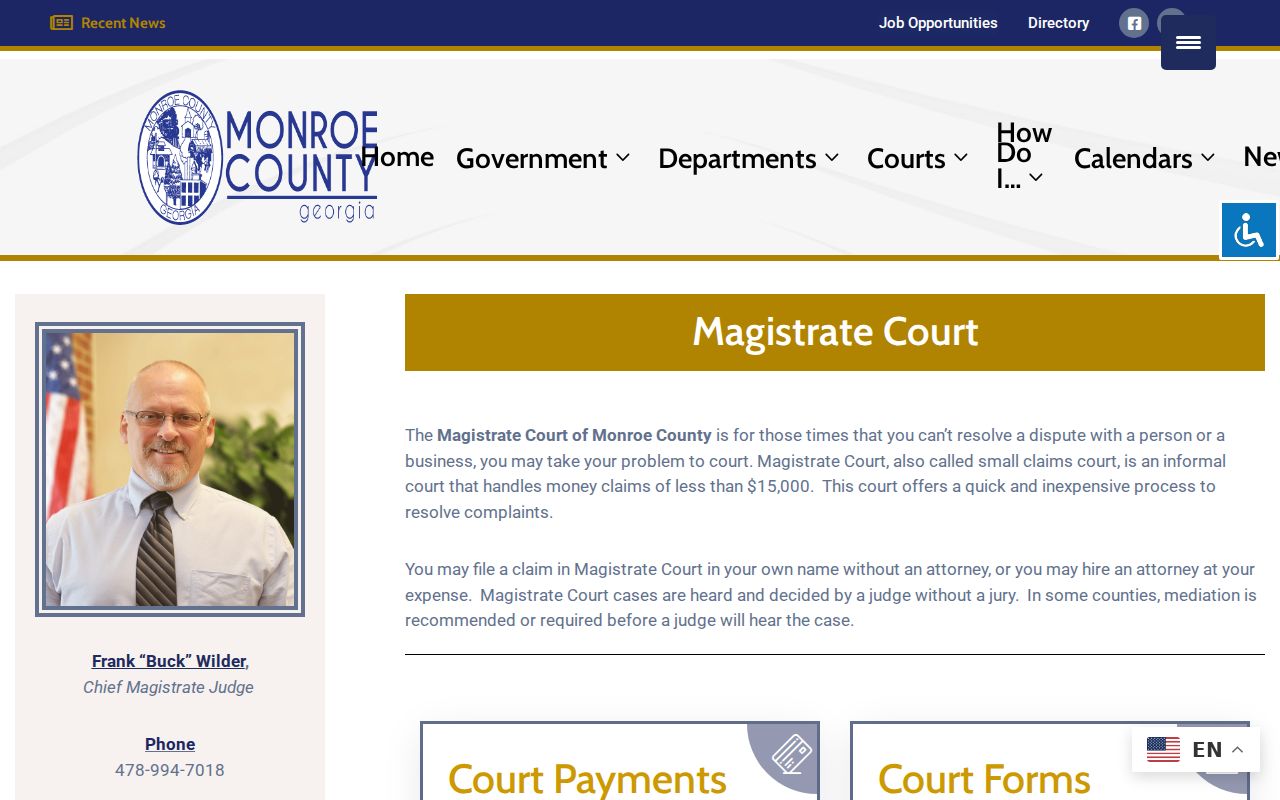
When eFileGeorgia returns no public Monroe County civil docket result, this local office page is the practical fallback.
Note: Confirm the physical address before visiting because official Monroe sources show both 143 and 145 L. Cary Bittick Drive.
Settings and Hearings on Civil Dockets
A civil setting shows up once a filing or motion reaches a point needing court action. That point is what triggers it. The docket may record status, discovery, mediation, motion, nonjury, jury, or trial events. Service and answer entries usually come first. A scheduling order can set deadlines and later hearings. A continuance or reset can move a date without ending the case.
Confirm any Monroe County civil hearing a few ways. Use the latest docket entry, a filed notice, or the clerk. A date in an old document is not a live calendar. A scheduled motion, likewise, does not disclose the ruling. The outcome belongs in a later entry or a filed order.
Civil docket flow: Filing → Service → Answer or Default → Motions and Settings → Judgment → Enforcement or Appeal
Monroe Civil Docket Filing Fees
The Monroe Magistrate fee schedule took effect July 1, 2024. It posts $113 as the total for a one-defendant statement of claim, dispossessory, foreclosure, or garnishment. Service is included in that figure. The breakdown is $63 to file and $50 for sheriff service. Added defendants at separate addresses cost $50 each. Re-serving corrected information costs the same $50. An abandoned-vehicle filing runs $49, and the listed Fi Fa is $29. These are local amounts, so confirm them with the clerk before you pay.
| Posted Magistrate item | Amount |
|---|---|
| Named one-defendant filing with service | $113 |
| Additional defendant at another address | $50 |
| Re-service after corrected information | $50 |
| Abandoned vehicle | $49 |
| Listed Fi Fa | $29 |
Card and convenience charges from the vendor may apply on top of those amounts. And a filing fee covers none of the costs of a docket copy or a certified judgment.
Read Monroe Civil Dispositions
Rule 39.2 packs a lot into one list. Dismissal with prejudice, dismissal without prejudice, settlement, summary judgment, default judgment, judgment on the pleadings, consent judgment, final decree, administrative termination, transfer, winner, mistrial, and a Fi Fa date each answer a different question about how a Monroe County civil docket ended. A settlement can wrap up the dispute with no finding from a trial. A default judgment comes out of the court's non-response process. And a dismissal alone does not settle the merits of the case.
- Final decree
- A final court order in a matter that uses decree terminology.
- Default judgment
- A judgment entered through the default process, not a trial finding after both sides present evidence.
- Fi Fa
- A writ of execution tied to judgment enforcement, not a second merits ruling.
- Remittitur
- The appellate mandate returning the case to the originating court when applicable.
Match the exact Monroe County civil docket label to the order itself, and only then describe what happened.
Request Monroe Civil Docket Records
Not every copy is the same. A docket sheet, a document image, an ordinary clerk copy, and a certified judgment serve different purposes. So ask for the one you actually need. The Superior cost schedule covers several categories. These include uncertified copies, certified or exemplified copies, computer printouts, electronic copies, transcript work, and seal or certification charges. PeachCourt lists per-page pricing for document purchases in many contexts too. Confirm the current amount before you pay, and check whether the image is already online.
If a record is missing, send a narrow written request to the office that holds it. Name the court, the exact case number, and the filing year. Add a party name, the filing or order you want, and whether you need certification. Georgia's Open Records Act request guidance favors a direct written request. Court exemptions and sealing rules still apply, though.
Protect Monroe Civil Docket Data
Public civil files may hold addresses and other personal details. Those details often have nothing to do with how a case moves through court. Two rules step in here. Rule 21.6 and O.C.G.A. §9-11-7.1 confine public filings to the last four digits of Social Security, taxpayer-identification, and financial-account numbers. The year of birth is allowed, and nothing more. The duty to redact sits with the filer, not the clerk. Rule 36.17 makes that allocation explicit. The clerk therefore does not act as a general privacy reviewer of every Monroe County civil docket filing.
Use the minimum record: Cite a case number, event, or order without copying unrelated personal data from a Monroe County civil docket.
A public docket records allegations and procedure. It says nothing about whether a complaint is true, or whether a party is financially reliable.
Monroe Civil Docket Access Limits
Seeing a case shell in PeachCourt is not the same as seeing the whole file. Whether a pleading or order shows up depends on several factors. These include your account status, the court's coverage, document availability, fees, and any sealing order. The clerk may still hold a paper copy or an older file. The vendor search never picks those up. So search by the exact case number first. Check the court and the year. Then fall back on the clerk if the docket entry looks thin.
Some Monroe County offices accept records requests by mail, fax, or email. The county publishes no single copy-submission method, though. It also promises no turnaround time. Ask before you send payment or original documents. Staff can walk you through filing and record procedures. Just remember the county's own materials: judges and clerks do not give legal advice.
Note: A missing online image is an access result, not proof that the Monroe County filing was never made.
Public Access to Civil Dockets
Civil dockets in Monroe County start from an open baseline. Uniform Superior Court Rule 21 makes court records public. A law or a court procedure must say otherwise for access to shrink. A party can still ask to limit access. Rule 21.1 spells out how that request works. For the court to grant it, Rule 21.2 sets a high bar: the risk of privacy harm must clearly outweigh the public's access. The format of a filing does not matter. Under Rule 36.16, an e-filed record carries the same force as paper. It holds the same public-access status too. Sealing, confidentiality, and redaction rules still apply to it.
Key Rules:
Uniform Superior Court Rules 21 and 36 address public access, restrictions, privacy, and e-filed records.
Uniform Superior Court Rule 39.2 defines the civil docket fields kept by the clerk.
Georgia Open Records Act guidance explains requests, response timing, costs, exemptions, and redaction.
Public access to the Monroe County civil docket does not mean every document is free or without limits. Confirm what you find with the clerk, and rely on the filed order, since that paper controls the result.
Monroe County Civil Docket Forms
Most people filing a civil case need standard forms. The Georgia Magistrate Council forms resource publishes the civil forms magistrate courts use, and it is the place to pull them before filing anything with the clerk.
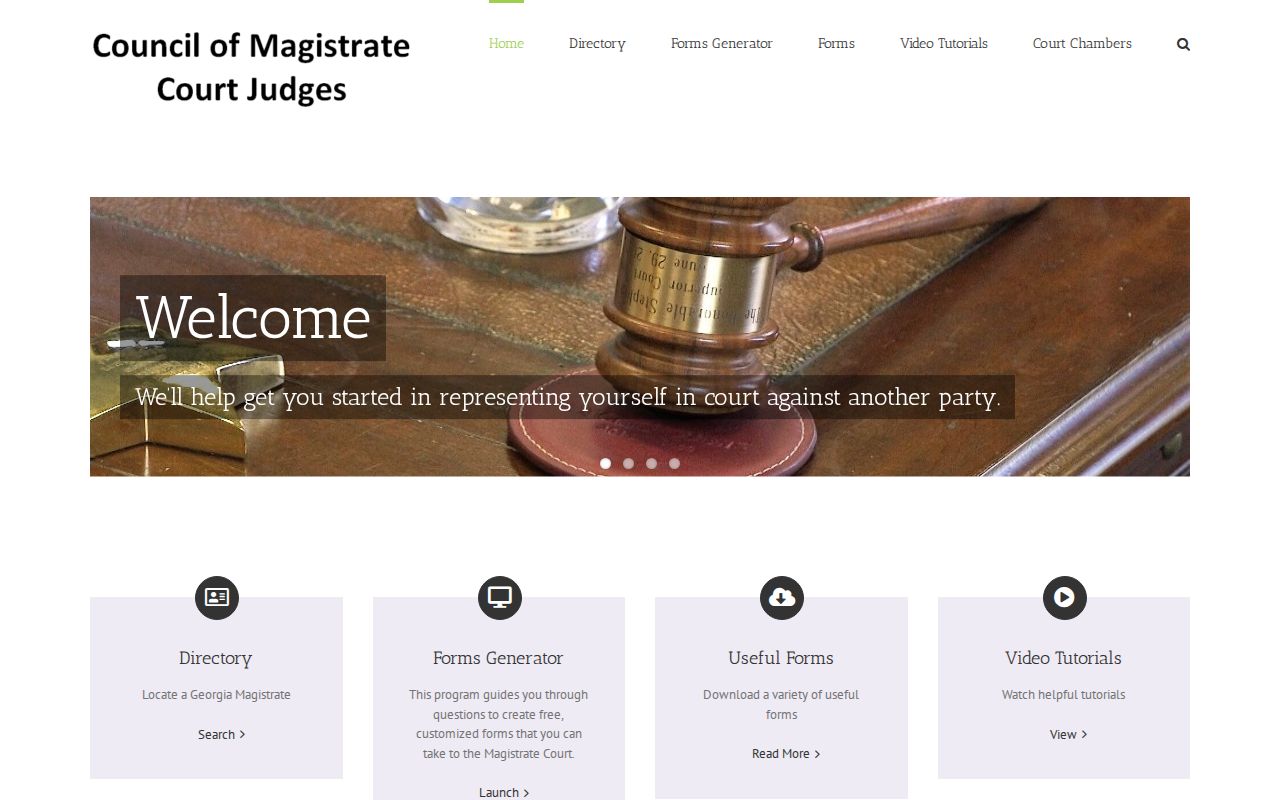
The statewide forms source covers the limited-claims process used in Monroe Magistrate Court, including the statement-of-claim route that local court materials describe. It is a forms resource only. It is not a public Monroe County civil docket index. Once your filing is in, use the case number and the Magistrate clerk to ask about the docket sheet, service, a setting, the judgment, or a copy.